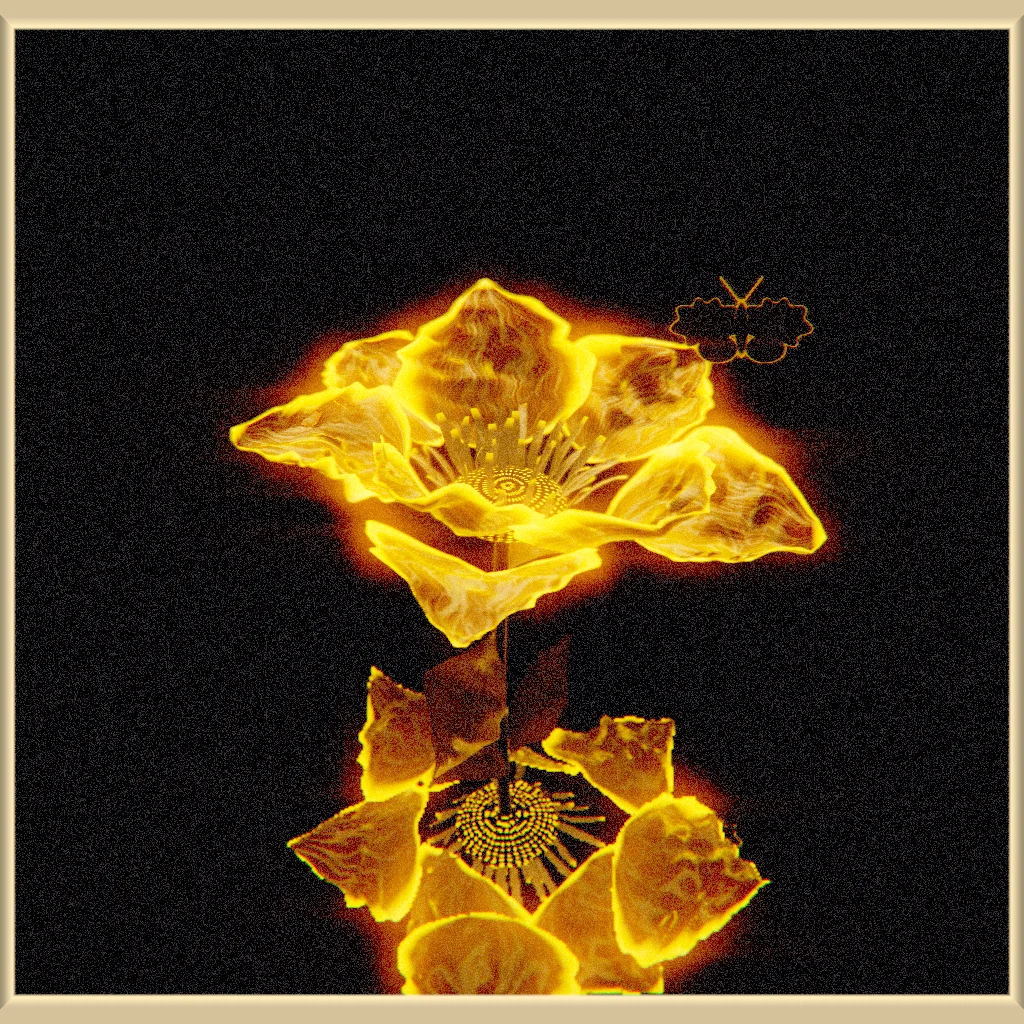
フラワーズ (Furawāzu) is a collection of 7,777 living, generative flowers: painterly, torn, neon-lit blooms seen through an anamorphic lens. Each one carries a seven-locus genome; its look is decided by Mendelian dominance and ten generations of Darwinian selection, not by a random roll. Every specimen blooms and wilts on a seven-day cycle, offset so the collection never blooms in sync.
Gregor Mendel crossed pea plants in a monastery garden and found that traits come in pairs: a dominant form hides a recessive one, and a true-breeding line carries two copies of the same form. Furawāzu inherits this directly. Every flower has two alleles at each of seven loci and expresses the most dominant one it carries. Pure Breeds are homozygous everywhere; that is why they breed true.
Charles Darwin supplied the rest: variation, selection, and the co-evolution of flowers with their pollinators. He predicted a moth with a foot-long tongue from the shape of an orchid decades before anyone found it. He also counted a 3:1-like ratio in peloric snapdragons and never recognised what Mendel would have. In Furawāzu, 50,000 seedlings were scored for contrast, harmony and readability; 7,770 survived, and a rare Predicted pollinator still waits, as an empty silhouette, for a creature not yet discovered.
Seven Pure Breeds and 500 wild founders were bred for ten generations with a small rate of self-pollination and 0.2% mutation per locus. Each generation, 777 survived. Tiers follow zygosity: 77 Heirlooms are true-breeding at all seven loci, 777 True Lines at six, and the rest are Hybrids. The whole population was frozen before mint; its SHA-256 is the provenance hash in the footer.
Two phases: allowlist, then public. Prices and limits are read live from the contract. Pure Breeds #1–#7 are reserved at deploy; every other token's genome was frozen and hashed before mint, so nothing is decided at mint time except which frozen specimen you receive.
Max 7 per wallet · 7,777 total
An ERC-721A token on Base whose on-chain record stores the SHA-256 hash of its frozen genome. The metadata API and the live artwork are served from this site; the still image and metadata show the flower at its peak.
Each piece runs a life cycle, bud → bloom → peak → wilt → seed, once every seven days of wall-clock time, with a phase offset from its genome hash. Open /piece/?id=N at different times and it will be at a different stage.
By genetics, not by weighted rolls. A recessive look only appears when both alleles are recessive, so recessive traits are naturally rarer. Tiers (Heirloom, True Line, Hybrid) follow how many loci are homozygous. Environmental traits (stage, season, pollinator, frame, sport) are seeded, not inherited.
Shattered-posture specimens are split into fragments that only line up from one true viewpoint. The live piece idles slightly off-axis; hover or drag and it eases into alignment. Pure Breeds always resolve perfectly.
Yes. The SHA-256 of genomes.json is published in the footer and set in the contract as the provenance hash; per-token genome hashes are stored on-chain at mint.
In your browser, from a shared engine (Three.js + custom shaders). A token carries only its genome; the engine expresses it. Nothing is pre-baked except the still image.